
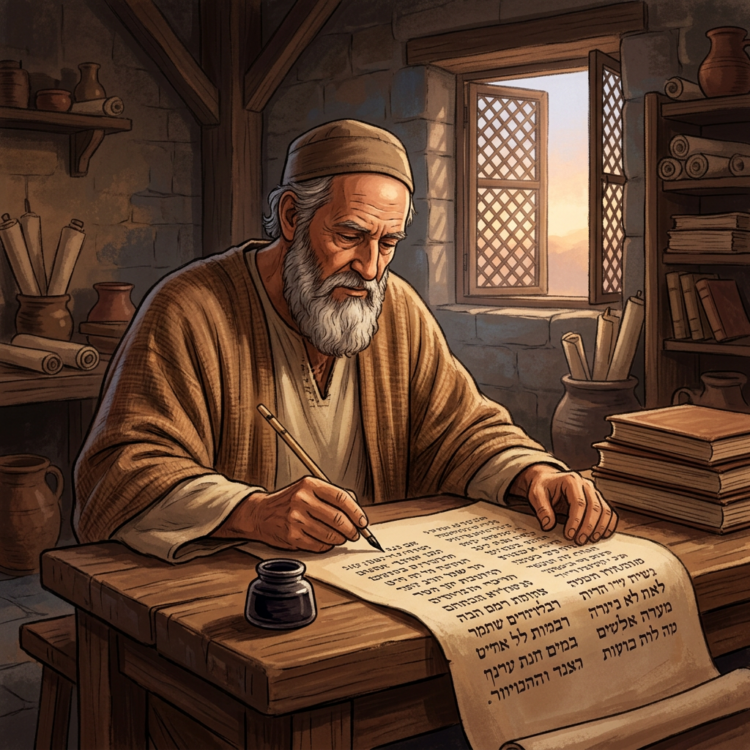
Someone recently pointed out that there is relatively little on this site about the Great Isaiah Scroll. Let’s fix that now.
Among the scrolls that were found in what is now known as Cave I in 1947 was the largest complete scroll to be found so far. It is also the only complete scroll of a biblical text to be discovered so far. Scholars call it the Great Isaih Scroll. This document includes (with the exception of a few damaged places) the entire text of the Book of Isaiah.
Visitors to the Shrine of the Book museum in Jerusalem can view a detailed replica on display there. Modern Israeli school children can read this document today. The language is completely familiar to them as there is little difference between modern Hebrew and that of the scrolls 2000 years ago.
As interesting as all of that is, there is so much more to be gleaned from this first-century document.
Similarity to Later Versions
The claims of so many Christian apologists notwithstanding, there are some (though fewer than one might expect) differences between the Masoretic text and that of the Isaiah Scroll.
That there are so few differences between this first century document and the Masoretic text (the oldest surviving copy of which is from 1000 years later) is less surprising when we consider the incredible rules ancient Jewish scholars enacted to ensure preservation of the original text.
To me, the reason this scroll is so incredibly important is that it underscores the hidden history of the movement that collected and preserved it. Today, scholars refer to the caretakers of these documents as the Essenes for reasons too elaborate to explore here. But they refer to themselves as the “Community” (יחד) as well as the “Chosen” or the “elect” (בחרים) and other designations modern readers would recognize.
The point is that the very designations they used to describe themselves are exactly the ones attributed to Jesus and his followers to describe themselves in the New Testament. These were the militant anti-Roman freedom fighters from what today is known as the archeological site of Qumran – but also from all over Judea in various towns they called “camps” (מחנות).
There are good reasons most of us never heard of these people. The Roman Empire and subsequently the Roman Catholic Church jumped through enormous hoops to ensure we never did. They wrote them out of the official stories that were written and commissioned by Flavian Roman leaders. It was those stories that were passed down to us as the New Testament and the works of Flavious Josephus.
Alas, these documents were not confiscated and destroyed because the Romans had no idea where they were. Neither did anyone else until they began to show up in the early twentieth century.
Because they wrote so much about who they were, what they believed, and why they were there, we now know precisely what was buried so long ago.
These folks literally stood in shifts reading scripture day and night to keep the sacred words on their lips through every moment of every day.
Interestingly, we also know one of the passages they read repeatedly was from Isaiah 40:3-5. The back of the scroll has stains from human hands as they unrolled to this section often.
You may recognize this passage as it is often quoted (and mistranslated) in the New Testament. This passage is rendered in the King James Version and most English translations as:
The voice of him that crieth in the wilderness, Prepare ye the way of the Lord, make straight in the desert a highway for our God.
Every valley shall be exalted, and every mountain and hill shall be made low: and the crooked shall be made straight, and the rough places plain:
And the glory of the Lord shall be revealed, and all flesh shall see it together: for the mouth of the Lord hath spoken it.
The translation problem is not in the actual words, but something that does not appear at all in the Hebrew text. The error is in the punctuation. The translators have placed a comma in the wrong place. And that completely changes the meaning.
The original Hebrew passage is written in metered poetry. Placing the comma (pause) after the word “wilderness” as in most English translations, totally obliterates the poetic flow of the reading. The arbitrary and incorrect positioning of the comma in many translations has led generations of readers to believe John was some lunatic wandering around the desert in camel skins and eating locusts.
A more accurate translation would be:
A voice calls out, “In the desert, clear the way of the Lord, straighten out in the wilderness, a highway for our God.”
Every valley shall be raised, and every mountain and hill shall be lowered, and the crooked terrain shall become a plain and the close mountains a valley.
And the glory of the Lord shall be revealed, and all flesh together shall see that the mouth of the Lord spoke.
But the Hebrew (which is the same here as the Masoretic text) says something entirely different.
First century believers, including Jesus’ cousin “John the Baptist” read the passage exactly this way. They took it as an imperative that the prophet who would prepare “the way” for the Messiah was to begin in the desert. That is why they made their speeches there; and that is why Jews like Jesus came out to the desert to hear them.
If you would like to dig deeper into the voluminous connections between these folks, John the Baptist, and family of Jesus check out my book The Second Crucifixion of Jesus.
Did Jesus Read These Scrolls?
A passage from the Book of Isaiah is referenced in the New Testament as one Jesus is said to have read in the synagogue.
The Masoretic text reads:
The spirit of the Lord God was upon me, since the Lord anointed me to bring tidings to the humble, He sent me to bind up the broken-hearted, to declare freedom for the captives, and for the prisoners to free from captivity.
This passage is apparently referenced in Luke 4:17-21 with the additional language thrown in.
And he came to Nazareth, where he had been brought up: and, as his custom was, he went into the synagogue on the sabbath day, and stood up for to read.
And there was delivered unto him the book of the prophet Esaias. And when he had opened the book, he found the place where it was written,
The Spirit of the Lord is upon me, because he hath anointed me to preach the gospel to the poor; he hath sent me to heal the brokenhearted, to preach deliverance to the captives, and recovering of sight to the blind, to set at liberty them that are bruised,
To preach the acceptable year of the Lord.
And he closed the book, and he gave it again to the minister, and sat down. And the eyes of all them that were in the synagogue were fastened on him.
And he said to them, This day is this scripture fulfilled in your ears.
There can be no credible argument that Jesus was unaware of these people. He was identified with them, by Roman officials on numerous occasions. The odds are extremely high that he read from at least one of these very scrolls at some time in his life.
If you would like to follow this journey, please add your name to the mailing list. You can sign up here.